![]() |
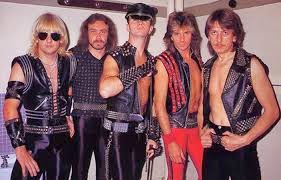
| Wow. This jacket is perhaps a little too extreme for me. I can't imagine actually wearing it. However, full marks for dedication and effort. Grade: 8.5/10. |
Showing posts with label JUDAS PRIEST. Show all posts
Sunday, October 12, 2014
PICTURE GALLERY: My favourite old-school battle jackets (in honour of 1984)
Thursday, July 10, 2014
HOT NEWS: New Judas Priest album out today, "Redeemer of Souls" (11 July 2014)
![]() |
| "Redeemer of the Souls" is the first studio album for new Priest guitarist Richie Faulkner who replaces guitar legend and long-time band member K.K. Downing. |
Record company: Sony Entertainment Limited
Track listing:
1 Dragonaut
2 Redeemer of Souls
3 Halls of Valhalla
4 Sword of Damocles
5 Mrch of the Damned
6 Down in Flames
7 Hell & Back
8 Cold Blooded
9 Metalizer
10 Crossfire
11 Secrets of the Dead
12 Battle Cry
13 Beginning of the End
Album line-up:
Rob Halford - vocals
Glenn Tipton - guitar
Richie Faulkner - guitar (ex-Voodoo Six)
Ian Hill - bass
Scott Travis - drums
![]() |
| Judas Priest British Steel line-up 1980. Left to Right: K.K. Downing (guitar), Ian Hill (bass), Rob Halford (vocals), Glenn Tipton (guitar), Dave Holland (drums) |
![]() |
| Judas Priest Killing Machine line-up 1978. Left to Right: Ian Hill (bass), Rob Halford (vocals), K.K. Downing (guitar), Glenn Tipton (guitar), Les Binks (drums) |
![]() |
| Judas Priest Painkiller line-up 1990. Left to Right: K. K.Downing (guitar), Ian Hill (bass), Rob Halford (vocals), Scott Travis (drums), Glenn Tipton (guitar) |
![]() |
| Rob Halford and Glenn Tipton live onstage |
![]() |
| Judas Priest in the early days around 1974. Bottom Row: K. K. Downing, Rob Halford, and Ian Hill. Top row: Unknown drummer (they used many drummers in the early years) and Glenn Tipton. |
![]() |
| Judas Priest live. Left to Right: K. K. Downing, Rob Halford, and Glenn Tipton |
![]() |
| Judas Priest Killing Machine line-up 1978. Left to Right: Les Binks (drums), Rob Halford (vocals), Ian Hill (bass), K.K. Downing (guitar), Glenn Tipton (guitar) |
![]() |
| The Priest in full flight - unbeatable! |
Saturday, November 17, 2012
ARTICLE: JUDAS PRIEST and the evils of modern-day capitalism (long live the Priest), by Kieran James
This is not a review of the brilliant British Steel album by JUDAS PRIEST (1980) as I have written a review for this album which appears on this website and on Amazon.com. Instead this article takes the three most well-known songs from this album (Breaking the Law, United, and Living After Midnight) to explore the band's presentation of life for unemployed youth under our capitalist mode of production.
| WARHAMMER from Yogya cover 'Rapid Fire" |
Firstly "Breaking the Law" was originally song three on the first side of the 12-inch vinyl. The narrator speaks of being unemployed and "drifting from town to town" with "anger in my heart". This shows how under capitalism the worker counts for nothing and company profits count for everything. You can do great work at a company for five or ten or twenty years but then a new evil bastard boss comes in and you are fired quickly usually for some tiny and trivial reason such as being ten minutes late for work, being a metalhead, having long hair, being Irish, or being black. The company has no human heart or compassion and does not care at all about you as a person or your family or all your great work over so many years. Yes it is an evil economic system. The narrator shouts out: "you don't know what it's like / you don't have a clue." This is true: rich bosses living in big mansions and driving executive cars have never felt worry or lack or fear or poverty. Under capitalism we are all isolated alienated alone individuals fighting each other for jobs and promotions and for the boss's hard-to-get love. We are hred alone and we are fired alone. Colleagues forget you one second after you walk out the door for the last time or they are happy to see you suffer. On this song PRIEST incorporated some punk lyrics and punk culture into metal. DEEP PURPLE or ZEPPELIN never sang about the unemployed or the harsh real life. Definitely punk improved metal because after the punk era 1976-79 metal bands such as SAXON and PRIEST began singing about unemployment and "living on the dark side, across the railroad tracks". "Breaking the Law" is a brilliant song because you can feel the genuine pain and frustration of the unemployed people and the low-paid casual worker in Rob Halford's brilliant vocal delivery. Congratulations to local Toowoomba band THERE'S NO SNAKES IN ALASKA for doing a wonderful cover version of this song. "Breaking the Law" talks about the harsh life of the unemployed during the monday-to-friday 9-to-5 working week when the bastard bosses rule and the people's voice is powerless.
![]() |
| HEAVY METAL LOVE: Bobby, Popo, Butche, Man |
"United", the last song on side one of the 12-inch vinyl album, is a football terrace chant following on from the very similar "Take on the World" from the 1978 album Killing Machine. This song has been called cheesy or wimpy by those people (often Americans or Australians) who have never stood on an English football terrace where these songs evoked great passions, tribal loyalies, and fears during an era when hardcore football hooliganism was reaching new heights as the skinhead era of the 1970s gave way to the "football casuals" era of the 1980s. The early-1980s was the time when football firms such as West Ham United's famous Inter-City Firm (ICF), Portsmouth's 6.57 Crew, Millwall's Bushwackers, Cardiff City's Soul Crew, Birmingham City's Zulus, and Chelsea's Headhunters had either formed or were about to form. All the members of JUDAS PRIEST are football fans. Rob Halford supports Walsall while long-serving bass player Ian Hill supports West Bromwich Albion (WBA). KK Downing and Glenn Tipton support football but I am not sure which team. Of course MAIDEN's Steve Harris is still known worldwide for his love of West Ham United. This PRIEST song "United" is not a song for either West Ham United or Manchester United. As mentioned, the members of PRIEST support teams from the West Midlands and there is no major United team in those parts. The song speaks of the joys and camaraderie the working-class people receive on Saturday afternoons on the football terraces when the bosses' evil rule ends for two days. The members of PRIEST follow punk band SHAM 69's call for the "kids to be united". If we have no power and we are forced into isolation from Monday to Friday our power grows as we enjoy the experience of togetherness at either the football or at a metal show. Around the world today many metalheads are also football fans. For twenty years (say 1967-87) the police in England were pretty much powerless to stop football hooliganism. Unity is the secret key to our power.
The last song I want to talk about is "Living After Midnight" which starts off side two of the 12-inch vinyl. This is such a powerful and dynamic song. Rob Halford is in a super happy mood because it is Saturday night in Birmingham and Rob is ready to hit the town with his mates or perhaps do a little gay cruising! The weekday suffering and boredom are left far behind because Saturday is party day and the cool people not the bosses rule the town. Rob "hits the city by the 1am loaded loaded". He "revs it up to start again". He "comes alive in the neon lights/ he is going to make his move tonight". PRIEST enjoys playing this song live with Halford getting in close with Tipton and Downing and the bodies swaying together and the guitar axes going up and down at the same time. I like Tipton's guitar solo here which uses the song's main regular riff which was also done in the same era by TWISTED SISTER on "We're not gonna' take it". Some say this song showed PRIEST's willingness to move in a more commercial direction. "You've Got Another Thing Coming" from 1982 was a far more commercial song and many people were very disappointed in PRIEST as the band had been one of the few to keep the metal flag flying high in the punk era (1976-79). I would not really agree that "Living After Midnight" indicated a new and bad commercial direction. This "Living After Midnight" song is happy, catchy, and cheerful, but it still has a hidden power, a quiet menace, and a brutal vibe. Don't get in Rob's way on a Saturday night - that is one of the messages here. The song is pure traditional metal, no wimping out at all. We join in Rob's power and excitement as he gets ready to hit the town. Life might be hard for the working-class in the West Midlands and around the world but the workplace rankings and hierarchies fall apart on Saturday nights when the good time gals (that is the name of a SLADE song from the 1970s) and guys come alive. Long Live the Priest!
[By Kieran James, 18 November 2012]
[By Kieran James, 18 November 2012]
Tuesday, November 8, 2011
REVIEWS: Classic album review: BRITISH STEEL by JUDAS PRIEST (1980)
First I want to briefly discuss Killing Machine (known as Hell Bent for Leather in the USA) and then move on to British Steel, so please bear with me...I heard both records for the first time late in 1984 or early in 1985 when I was 16 years old and new to the metal scene...
Killing Machine was a great record, it was released in 1978 and was Priest's first experiment with its new stripped-down sound, shorter songs and more direct lyrics. As such, while individual songs on Killing Machine were great (actually they nearly all were), the album had a very experimental feel to it, and you felt that still better was to come.
British Steel was released two years after Killing Machine, and you felt the band had matured a lot and grown heaps in self-confidence. The live album Unleashed In The East kept the fans' interest in the band alive throughout 1979. Another change took place before British Steel was recorded, with Les Binks being replaced by Dave Holland on drums (sadly incarcerated now for sex offences - forever remembered in my mind for the drum intro on "Riding On The Wind"). The heart and soul of the band, Rob Halford on vocals, KK Downing and Glenn Tipton on guitars and Ian Hill on bass, remained in place for British Steel.
What can I say about British Steel itself? I loved it, I just loved the overall sound that the band managed to produce. It was similar to Killing Machine in basic style, sound and direction, but there was more of the feeling of the songs being linked together as a complete package. The sound was still raw, but it was slightly more polished, and by the time Screaming for Vengeance came out in 1982 the band would head further in the direction of the polished sound. Halford's voice is at its best on British Steel, authoritative, powerful, passionate, able to hit the very low and high notes, and suitably aggressive in the right places.
The album starts with "Rapid Fire", a speed-metal track ahead of its time, that just keeps on keeping on as the words and riffs just continue unabated, with not much variation in the tone, just a grinding repetitive rythmn, and no sign of an identifiable chorus either. It's a similar opener to "Delivering The Goods" on Killing Machine, but in this case I feel the Killing Machine opener is better, but not by much. [Young Yogyakarta, Indonesia death-metal band Warhammer does a great cover of "Rapid Fire" and I hope that they can record it.]
"Metal Gods" is anthemic in nature with the powerful chorus of "Metal Gods", backed up by the dragging of chains sound effect that occurs at the same time as the main riff, and its timing and volume mixed in with the regular guitar sound is just perfect, and chilling in its effectiveness. The chains sound is not too loud or too buried. The subject matter - which I didn't realize back in the day (no lyrics came with the album) - is about security cameras, as on the song "Electric Eye".
"Grinder" is a standard, fairly slow, menacing and brooding heavy number. The main riff of this song and "Creeping Death" by Metallica seem somehow similar to me. However, to my knowledge no-one else has ever said this, now or then, so maybe I'm missing something.
"United" is a sing-along fun anthem ("Take on the World" Part II), focusing on the togetherness and unity of metal fans back then, which is sadly (in my opinion) much lesser nowadays (but now is better than the 90s) because the genre has split up into thrash, death, black, melodic death, metalcore, etc. and many people are interested only in one or two of the sub-genres. So the early to mid 1980s were really a unique time in metal history, and "United" sums up the feeling of the times well. Back in the 1980s, metal was metal, and those that loved Motley Crue also loved Slayer and Metallica. Yes, the song was cheesy but think what Queen was doing back then.
On the original vinyl LP version, "Living After Midnight" kicked off side two with a bang. A great song, more commercially oriented, but its still definitely Priest in character and heart (in my opinion). It has so much energy and simplicity, and just simply rocks.
I was in a cafe in the entertainment district of Perth, Australia called Northbridge with a Canadian friend (Mark R.) one Sunday night two years ago. We both found out, almost stumbling upon it by accident, that we were two 80s metalheads in hiding. Thirty seconds later and we were both singing the chorus of "Living After Midnight"!
So I think this is the best Priest record. The title says it all. It summarized what Priest was all about - reliable, trustworthy, tough, unashamedly patriotic, resolute, cheerful. I'm glad the band didn't call the album Living After Midnight and make that song the title track. British Steel sums up best what the band was all about circa 1980.
FOOTNOTE (added 9 June 2006): I have noticed on certain internet chat forums, it has become cool among some people to bash this record, and heap praise on all the Priest records that came before it and after it. This is just re-writing history in my opinion. Back in the day the vast majority of fans loved British Steel, and regarded it as a positive move forward for the band. It should also be noted that whilst "Breaking The Law" and "Living After Midnight" are not bad songs at all, they are not representative of the album taken as a whole.
Killing Machine was a great record, it was released in 1978 and was Priest's first experiment with its new stripped-down sound, shorter songs and more direct lyrics. As such, while individual songs on Killing Machine were great (actually they nearly all were), the album had a very experimental feel to it, and you felt that still better was to come.
British Steel was released two years after Killing Machine, and you felt the band had matured a lot and grown heaps in self-confidence. The live album Unleashed In The East kept the fans' interest in the band alive throughout 1979. Another change took place before British Steel was recorded, with Les Binks being replaced by Dave Holland on drums (sadly incarcerated now for sex offences - forever remembered in my mind for the drum intro on "Riding On The Wind"). The heart and soul of the band, Rob Halford on vocals, KK Downing and Glenn Tipton on guitars and Ian Hill on bass, remained in place for British Steel.
What can I say about British Steel itself? I loved it, I just loved the overall sound that the band managed to produce. It was similar to Killing Machine in basic style, sound and direction, but there was more of the feeling of the songs being linked together as a complete package. The sound was still raw, but it was slightly more polished, and by the time Screaming for Vengeance came out in 1982 the band would head further in the direction of the polished sound. Halford's voice is at its best on British Steel, authoritative, powerful, passionate, able to hit the very low and high notes, and suitably aggressive in the right places.
The album starts with "Rapid Fire", a speed-metal track ahead of its time, that just keeps on keeping on as the words and riffs just continue unabated, with not much variation in the tone, just a grinding repetitive rythmn, and no sign of an identifiable chorus either. It's a similar opener to "Delivering The Goods" on Killing Machine, but in this case I feel the Killing Machine opener is better, but not by much. [Young Yogyakarta, Indonesia death-metal band Warhammer does a great cover of "Rapid Fire" and I hope that they can record it.]
"Metal Gods" is anthemic in nature with the powerful chorus of "Metal Gods", backed up by the dragging of chains sound effect that occurs at the same time as the main riff, and its timing and volume mixed in with the regular guitar sound is just perfect, and chilling in its effectiveness. The chains sound is not too loud or too buried. The subject matter - which I didn't realize back in the day (no lyrics came with the album) - is about security cameras, as on the song "Electric Eye".
"Grinder" is a standard, fairly slow, menacing and brooding heavy number. The main riff of this song and "Creeping Death" by Metallica seem somehow similar to me. However, to my knowledge no-one else has ever said this, now or then, so maybe I'm missing something.
"United" is a sing-along fun anthem ("Take on the World" Part II), focusing on the togetherness and unity of metal fans back then, which is sadly (in my opinion) much lesser nowadays (but now is better than the 90s) because the genre has split up into thrash, death, black, melodic death, metalcore, etc. and many people are interested only in one or two of the sub-genres. So the early to mid 1980s were really a unique time in metal history, and "United" sums up the feeling of the times well. Back in the 1980s, metal was metal, and those that loved Motley Crue also loved Slayer and Metallica. Yes, the song was cheesy but think what Queen was doing back then.
On the original vinyl LP version, "Living After Midnight" kicked off side two with a bang. A great song, more commercially oriented, but its still definitely Priest in character and heart (in my opinion). It has so much energy and simplicity, and just simply rocks.
I was in a cafe in the entertainment district of Perth, Australia called Northbridge with a Canadian friend (Mark R.) one Sunday night two years ago. We both found out, almost stumbling upon it by accident, that we were two 80s metalheads in hiding. Thirty seconds later and we were both singing the chorus of "Living After Midnight"!
So I think this is the best Priest record. The title says it all. It summarized what Priest was all about - reliable, trustworthy, tough, unashamedly patriotic, resolute, cheerful. I'm glad the band didn't call the album Living After Midnight and make that song the title track. British Steel sums up best what the band was all about circa 1980.
FOOTNOTE (added 9 June 2006): I have noticed on certain internet chat forums, it has become cool among some people to bash this record, and heap praise on all the Priest records that came before it and after it. This is just re-writing history in my opinion. Back in the day the vast majority of fans loved British Steel, and regarded it as a positive move forward for the band. It should also be noted that whilst "Breaking The Law" and "Living After Midnight" are not bad songs at all, they are not representative of the album taken as a whole.
By Jack Frost, first posted on Amazon.com 24 March 2005.
Subscribe to:
Posts (Atom)